Sweet Streets - Independent in the Industry
This month’s sweet street is Quebec Street in Prince George, British Columbia.
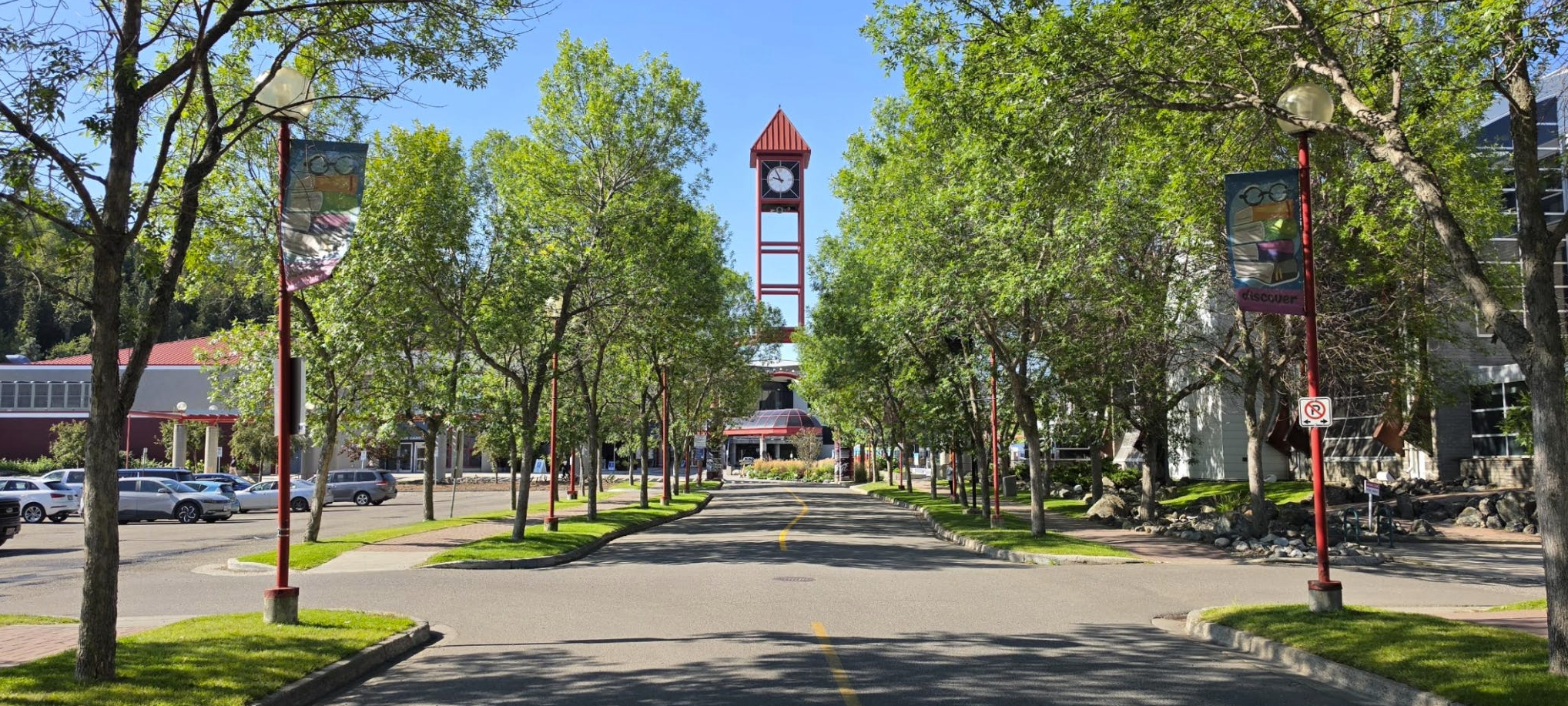
Quebec Street is a fairly unassuming roadway in town. It’s brief, only running several blocks downtown. It is also fairly quiet within the context of more commercial heavy streets downtown such as 3rd Avenue and Victoria. Despite all of this, Quebec street is the quintessential example of end vistas for Prince George. At the northern end of Quebec sits the Via Rail station, an entry point into the community. At the south end, Prince George’s main library, clocktower, and the general civic and recreational hub for downtown. So, what is an end vista, what purpose does it serve, and how can we see this sort of planning show up on Quebec street and elsewhere?
Prince George is a community that was first incorporated in 1915. The initial founding of the townsite came after the Grand Trunk Pacific Railway purchased what is now formally known as the Fort George Indian Reserve No. 1. A common practice during the era was to preplan communities and as such, the GTPR hired the firm Brett, Hall and Company based out of Boston to design it.
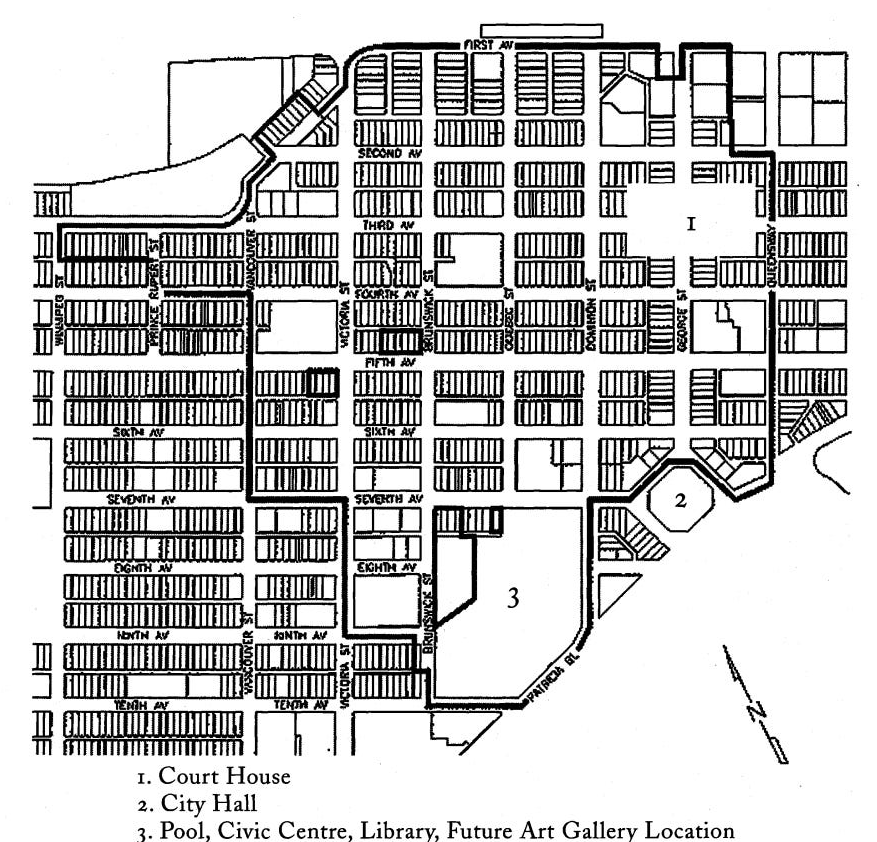
Rooted in the movement of “City Beautiful”, Prince George’s original townsite, Fort George, showcased several elements of the design style such as “diagonal avenues, radial streets, civic plazas, and public squares” (Curry and Llewellyn 73). In essence, the purpose of City Beautiful, and by extension the design of the Fort George Townsite, was to provide for open concept, grandeur and an emphasis on connection to important municipal spaces such as parks.
One critical aspect to City Beautiful design is the concept of end vistas. This is essentially the view you have at the end of a thoroughfare (Lynch 38). In the case of Prince George, the primary axis in which this was planned for was George Street, which was to be “terminated at the northern end by a small park, defined by short diagonal streets, the railway station and a major hotel. Octagonal shaped Princess Square containing City Hall was to terminate at the south end” (Sedgwick). Basically, City Beautiful design requires grandeur and an emphasis on axis planning and nodes of activity. PG planned for and did this, but instead of seeing this come to fruition on George Street, the real end vistas are on Quebec.
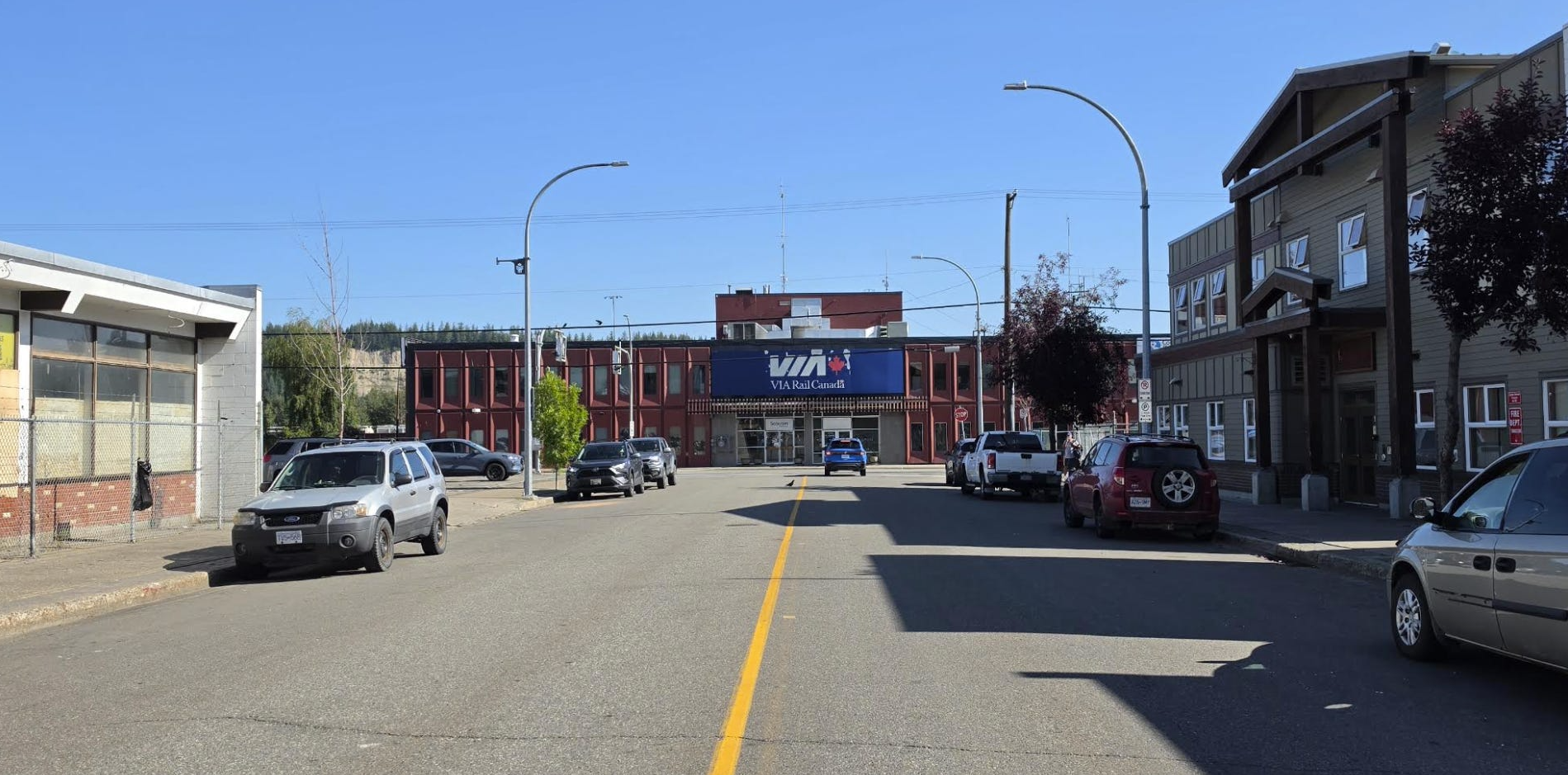
Looking north on Quebec we can see the Via Rail station, on the south end, the library and its clock tower.
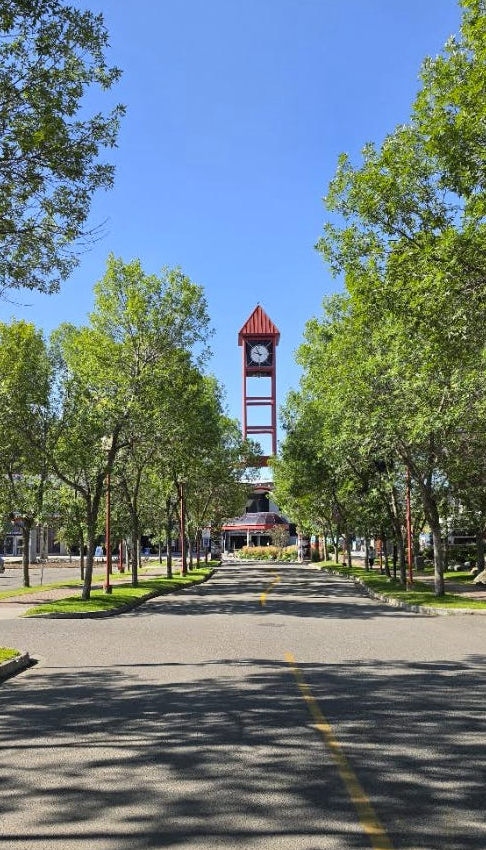
And thus the planning concept has been achieved and there’s a sort of niceness to Quebec Street as a result.
So what is the value in an end vista? Planning as a field is about many things. In some ways, the definition of a noun is almost equal to what planning is concerned with, people, places and things. Core to the values of a planner is doing well for communities. While simple, the quality and enjoyability that a view provides people with is important. Planning roadways, vantage points and more to feature areas of significance, whether it be something of natural beauty, community importance or otherwise does make a difference. So, the value, while simple, is to make everyone’s life and enjoyment of communities just a little bit better.
Independents in the Industry
This month’s theme is independents in the industry. We’ll hear from two independent professionals, Ben and Desiree, both of whom have been working in planning and adjacent fields such as government relations, community engagement, policy, First Nations development, wellness and reconciliation. They share their experiences as an independent professional working in an industry filled with opportunity, challenges, ups, downs and everything in between.
Benjamin Neff:
A few months ago, I sat across from a client staring down a removal deadline for structures they’d built without an approved permit. That sounds bad on its face, until you know the rest: the application had been sitting with municipal staff for years, with no clear timeline and no end in sight. Eventually the client made a call a lot of people in agriculture make when the system stalls out on them. They built what they needed to run their operation, and waited for the process to catch up. Nothing malicious, just a process that stalled so long the file became a compliance problem instead of the practical land use question it actually was.
I run Hoftag Consulting, a Langley-based practice supporting clients across British Columbia. The work spans community planning, permitting, public policy, election campaigns, and public affairs, but it’s really one job: helping people navigate how decisions actually get made, whether that’s with a municipality, a Nation, or a private landowner trying to move a file forward.
Independence means I can follow a problem in a file wherever it needs to go, without being boxed in by expectations, billables, or hierarchy. A municipality sees compliance, a developer sees timeline, a Nation sees jurisdiction. All legitimate, none complete on its own. Independence lets me move between those perspectives and answer to the outcome itself.
The hardest part is capacity. There’s no bench of colleagues to hand a file to when three things land at once, so the work is always mine to carry. The best part is trust. Clients and municipal staff alike know they’re dealing with the same person from first call to final approval, and that consistency is worth more than most processes ever are.
Independent work only matters if it actually helps the community it sits in. Land use is part of it. When a file moves from stalled to resolved, it can mean a family staying on land they’ve worked for years, or a Nation asserting jurisdiction the way it should, or a business able to start or expand, or a neighbourhood avoiding a fight that never needed to happen. But the impact goes beyond land use. Just as often it’s someone finally getting a straight answer from government after months of running in circles, or a candidate getting elected who’ll actually represent their community once in office. For organizations, it can mean building the internal structure that protects them long after the file I’m working on is closed. Different problems, same goal: helping people, and the places they call home, get unstuck.
If you’re early in your career and wondering what it takes to do that kind of work, here’s the honest answer: it doesn’t come from technical skill alone. It comes from relationships and credibility built over time, long before you’re the one people trust with a hard file. Learn to sit across from government, industry, and community, and actually understand all three. That’s the skill nobody teaches you in school, and it’s the one that matters most.
Desiree Baker:
I started Robin’s Eye View Consulting Inc. in 2023 because I wanted to do more than I had before. Most of my clients are First Nations communities, non-profits and registered charities. Many communities need funding for cultural work, housing, education, language, food sovereignty and economic development, and helping them reach those goals is important work. I always wanted to support their economic development and funding in a more meaningful way, and now I can.
I work independently because I have the knowledge and experience for First Nations cultural safety and trauma-informed work, along with over 30 years working with communities. I have learned cultural protocols and I do my work in a good way.
In a way, I prefer it. I take the clients I want to work with when requested. Most of my work comes from referrals, though I also answer requests for proposals and get work that way as well. I can take holidays when I want, or take my grandson for the day. It is nice working for myself and doing what I like, when I like.
That independence comes with challenges. Sometimes I need support, and usually quickly, something like that always comes up. So I surround myself with great people who can assist, with different skill sets. I have people I call on and work with who help when needed. When projects get large, or I have a few going at once, there are supports in place. One of the people I work most closely with is Alex. I own the company and Alex partners with me on the work, but to the communities we serve, we show up as one team.
The best part of working independently is that I answer only to myself, my clients and their communities. And I can partner with other consultants and other companies when it is beneficial to all parties.
The most fulfilling work I’ve done has been with one community over several years. Alex and I have helped them secure over $3 million in funding, and then we worked together to complete all the projects. We got funding to do a community economic development plan, a labour market study, a career fair, a harbour use plan, and architect drawings for their information centre, which may include an economic incubator for local entrepreneurs. To assist with something so impactful to their economic development has been amazing. Beyond all those great things, I have become good friends with the people we work with and many others in the community, and I have got to travel to their beautiful community many times. The work with communities is rewarding in so many ways.
The way I see it, we plan together, and I hopefully find funding for them to do that work. I get to do engagement with them, so I learn their protocols, how the band office works, and then the engagement itself. They share their hopes and dreams, and I get to assist in making those a reality. My network is vast and trusted, so I share all the best technology and companies with them.
For anyone coming up in this industry, my advice is to build relationships first. Earn communities’ trust and learn how to assist them. Do work to help, we all need money in this world, but relationships and trust are worth more. Learn from others, and ask successful people to mentor you. It is best to learn from people with experience.
In the News
An interesting debate going on in Vancouver right now is whether to upzone properties or reduce zoning restrictiveness in general. On one side of the debate is TEAM for a livable Vancouver. Their plan is to see the upzoning of some nearly 2,400 properties along Vancouver’s busiest thoroughfares, adding to the potential density and centralization of medium to high impact commercial uses in areas of high impact and use to the community. The other side of the zoning conversation has OneCity who are pitching a deregulation of what sort of commercial activities can be done out of your home, such as bike repair shops, corner stores, salons, and other low impact uses. The angle here is more so built around the notion of organic commercial growth so long as it doesn’t noticeably impact the character of neighbourhoods. So, what’s better?
Really, these policy proposals are trying to do the same thing in different ways, unlock land for additional use. One is very obvious in how it densifies uses because it literally increases the allowable footprint of businesses in Vancouver, while the other proposal seeks to find areas of underuse that could otherwise fill low impact gaps. With that being said, there isn’t really a better policy. It’s like taking Advil and Tylenol for a headache. Both work, just in different ways. While effectiveness and success of policies will always be up for debate, and there certainly will be a disparity between which of the two policies is going to fundamentally do more for the City, the best approach in order to solve the problem of limited land for commercial use would likely be the adoption of both policies.
Resources
Sweet Streets:
Curry, John, and Jason Llewellyn. “The Revitalization of Downtown Prince George.” BC Studies, no. 124, winter 1999–2000, pp. 69–92.
Lynch, Kevin. The Image of the City. MIT Press, 1960.
Sedgwick, Kent. Prince George: A City Beautiful Plan. Western Canadian Association of Geographers.
In the News:
https://dailyhive.com/vancouver/onecity-vancouver-home-based-businesses-proposal
